- Blooms
- Growing in the dex!
- BSkCold semi-arid
- CsaHot-summer Mediterranean
- DsaMediterranean hot-summer continental
- CfbOceanic
Saffron has no wild home. It is a sterile clone that arose, almost certainly just once and probably near Athens, from a wild crocus called Crocus cartwrightianus. Because it cannot set seed, every saffron corm on earth was planted by someone. Each lilac flower holds the prize: three long crimson threads (the stigmas) that spill over the edge of the flower. One kilogram of dried saffron takes somewhere between 110,000 and 170,000 hand-picked flowers.
Its year runs backwards compared with most plants. The corm sleeps through the summer, and during that sleep it forms next autumn's flowers, in the dark, best at 23–27 °C. Once the soil cools and the first real water arrives, the flowers come up in October. Fine, grass-like leaves then stay up all winter, feeding the new corms that will replace the old one, and by June the plant has died back again. To grow it: plant the corms deep, keep them warm and dry over the summer, and pick each flower in the morning as it opens.
Ideal habitat
tolerates 2–34 % · happiest 5–25 % · Dry-summer steppe profile
tolerates 0–480 klx·h a day · happiest 0–260 klx·h a day · Dry-summer steppe profile
tolerates 36–82 °F · happiest 50–77 °F · Dry-summer steppe profile
tolerates 25–85 % · happiest 45–65 % · Dry-summer steppe profile
shaded band = tolerated range · dotted line = happiest — the same targets an Autopod steers by.
Year by year
Getting started
arrives as dry corms in late summer — and a big corm (8 g and up) has this autumn's flowers already built inside it
Typical timeline
Care milestones
Botanical drawing
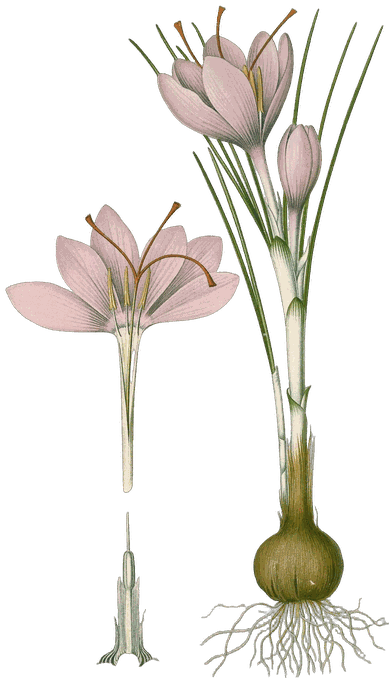
Köhler's Medizinal-Pflanzen, pl. 164 (1890) — Crocus sativus L.: the corm, the plant, and a flower split to show its three stigmas
See one growing
Real plants in real jungles, on live sensors.
Page history
- rev 1currentseed bake from the curated registrythe dex · 2026-10-27
Everything on this page is available under CC BY-SA 4.0.